

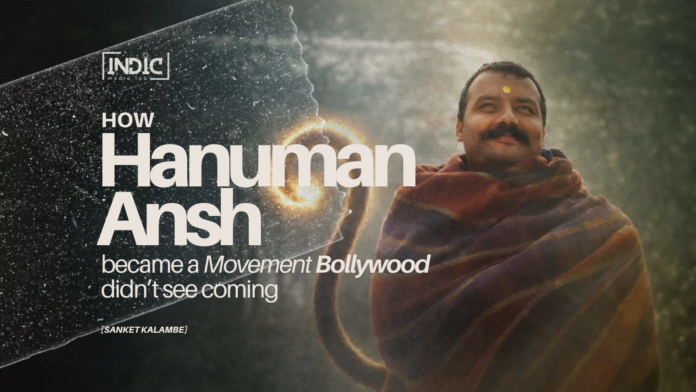
In the Age of Toxic-ity, Bharat Chose Hanuman Ansh
There is an irony in the Indian box office of 2026 that deserves more attention than another list of hits and flops.
Hanuman Ansh, inspired by the life of Neem Karoli Baba, arrived without most of what the film industry usually considers necessary for a national theatrical phenomenon. The movie had no superstar opening. No giant promotional machine. No enormous production budget. No attempt to make the film unavoidable before anyone had actually watched it.
Made for around ₹2 crore, it began modestly. Its first week brought in barely ₹1 crore. By the usual logic of theatrical cinema, that should have been enough to write the endgame.
Instead, the third week became bigger than the first. The fourth exploded. The fifth became its strongest week. By the end of September, after more than fifty days in theatres, Hanuman Ansh had crossed ₹400 crore worldwide and was still drawing audiences. Its fifth week alone reportedly brought in more than ₹90 crore.
The number is remarkable. The journey is more revealing.
Somewhere along that journey, Hanuman Ansh stopped behaving like an ordinary film release. People were not only buying tickets; they were carrying the film forward – through families, devotional communities, songs, conversations and repeat visits. What began as a small theatrical release was beginning to look like a cultural movement.
Not a movement organised from above, and certainly not one created by a marketing department. It grew because people recognised something in the film and wanted others to encounter it too.
Perhaps that movement grew because the film quietly challenged several assumptions Bollywood had begun treating as rules: that scale creates importance, that stars create connection, that spirituality needs spectacle, and that an Indian audience must first be persuaded to value what already belongs to its cultural memory.
Hanuman Ansh tested those assumptions one by one.
The audience did not merely watch this film.
They’ve carried it.
When the Audience Became the Distributor
At one stage, Hanuman Ansh had reportedly fallen from hundreds of screens to a fraction of that number. Producer Anupriya Nagar has spoken about the struggle of those early days, when conventional industry confidence in the film was still missing.
Yet recommendations continued travelling.
One person told another. Families returned with families. Devotional communities began talking about the film. Songs travelled through reels and WhatsApp groups. Screens eventually came back because demand made ignoring the film harder than exhibiting it.
There is something important in that reversal.
For most of cinema’s history, distribution decided what an audience would get the opportunity to discover. Today, audiences can sometimes push back against that judgement.
A recommendation in a family group may look insignificant beside a national advertising campaign. Multiply it by thousands, and it becomes another kind of distribution network.
This does not make publicity irrelevant. Nor does it mean every small film can simply wait for word of mouth to rescue it.
But an opening weekend and an eighth week tell us different things.
The opening tells us how successfully attention was created before people watched the film.
The eighth week tells us whether people who watched it wanted somebody else to watch it too.
That is why the economics of Hanuman Ansh should interest filmmakers who may never make a spiritual film.
The larger question is not: How do we make another ₹400-crore devotional movie?
It is: what did audiences find here that the industry’s usual systems failed to see at first?
The answer may begin with an old word.
Rasa.
Beyond Content: Rasa
“Content is king” has become one of the safest sentences in the film business.
But content tells us what a film contains.
Rasa tells us what stays with us.
That distinction matters with Hanuman Ansh because the film is not built around an unusually complicated plot. Director Vishal Chaturvedi does not try to convert Neem Karoli Baba into a cinematic superhero. Every scene does not have to become a confrontation. Maharaj-ji does not keep proving that he is extraordinary.
Humour is allowed to remain gentle. Silence is allowed to remain. There are moments where the film seems comfortable leaving something unexplained.
The sacred does not constantly announce that it is sacred.
That restraint matters.
It would be easy to misread the lesson and conclude that spiritual cinema must therefore be small, visually restrained or austere. Mahavatar Narsimha has already shown that grandeur and devotion can work beautifully together.
The question is not spectacle versus simplicity.
It is whether spectacle grows from the emotional truth of the story—or is brought in because the filmmaker no longer trusts that truth to hold us.
Hanuman Ansh often chooses trust.
The music does the same.
It does not feel placed on top of the film. It feels as if it has come from the same devotional soil. Maine Tere Hi Bharose Hanuman works not because it pauses the story for a song, but because it carries the bhāva of surrender beyond the scene itself. When a song begins to live independently in homes, reels and voices far beyond the theatre, the film has already travelled beyond entertainment into cultural memory.
The voice behind that song makes this even more interesting.
Suneel Lodhi, a visually impaired folk singer from Bundelkhand, had spent years singing bhajans and traditional songs with his tambura. His voice was not designed in a studio to sound “rooted”. It already came from that world.
And perhaps this is where the film’s sincerity begins to show itself.
Not only in what appears on screen, but in the relationship its makers seem to have had with what they were filming.
Shraddhā Behind the Camera
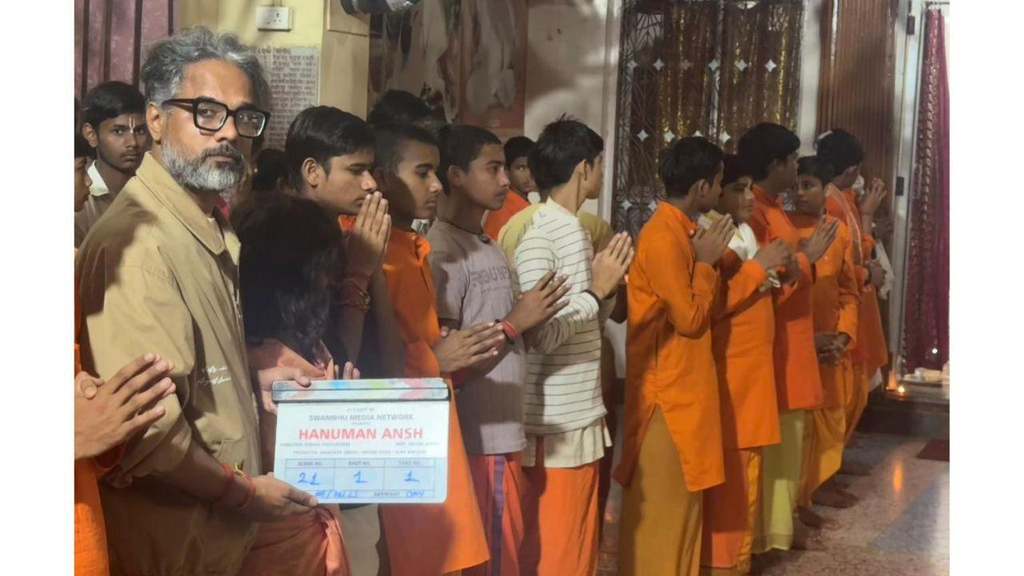
Vishal Chaturvedi has spoken about the disciplines followed during the making of Hanuman Ansh.
The set was kept vegetarian. For the actors portraying Neem Karoli Baba, he had conditions around food, alcohol and conduct. Chaturvedi himself followed a fruit-based diet for months during the production period. He has spoken of the Hanuman Chalisa being part of that journey, and of approaching the film less as an ordinary assignment than as something carrying responsibility.
None of this guarantees good cinema.
A vegetarian set cannot rescue a weak screenplay. Spiritual discipline cannot replace craft.
That is not the point.
The interesting thing is that the makers seem to have felt that portraying Maharaj-ji placed certain demands upon them beyond costume, resemblance and dialogue.
There was shraddhā.
Not shraddhā as a marketing label added after the film became successful, but a certain care about what one was handling.
That can influence artistic choices more than we usually acknowledge.
A filmmaker standing outside a tradition may ask: How do I make this scene bigger? Where can we add conflict? What will make the trailer more dramatic?
Someone approaching the same material with shraddhā may occasionally ask the opposite question: What should I leave alone? Where should I step back? What belongs to me as a storyteller, and what am I merely borrowing from a life that people already hold sacred?
That restraint becomes part of the filmmaking.
The casting of Shobhinaw Satyaa is a good example.
Satyaa was working behind the camera as an assistant director when the original lead became unavailable. Vishal eventually took him to Chitrakoot and auditioned him for hours before deciding he could carry the role. Satyaa also happened to fit the lifestyle Vishal had imagined for the person playing Maharaj-ji: vegetarian, non-drinking, and someone who did not habitually use abusive language.
His casting does not prove that training or experience are irrelevant.
It proves something more useful.
Celebrity and screen authority are not the same thing.
Sometimes a famous actor brings enormous weight to a character. At other times, fame itself sits between the character and the audience.
With an unfamiliar face, something else can happen.
The performer begins to disappear.
There are also anecdotes from the production that naturally acquire another meaning within the devotional world surrounding Maharaj-ji.
Vishal has recalled choosing an old room in Chitrakoot because it worked visually for a scene, only to later learn that Neem Karoli Baba himself had once stayed there. He has spoken of a langur remaining around the unit during Hanuman-related filming.
One can call such things coincidence.
The devotee has another word available:
Anugraha.
Grace.
There is no need to force one interpretation upon the other. But an Indic account should not become so uncomfortable with the metaphysical that it edits out the vocabulary through which the people involved themselves understand the experience.
And the idea of Dharma did not remain entirely inside the film.
After Suneel Lodhi’s voice reached a national audience, Anupriya Nagar stepped forward to support specialist evaluation and possible treatment for his visual impairment. The medical outcome remains uncertain, as it should honestly be described.
But the gesture matters.
A film speaking of sevā creates an occasion for sevā outside the frame.
That says more about “Dharma in action” than a promotional slogan ever could.
When the Actor Gives Way to the Swarūpa
Perhaps this also explains something about the response to Shobhinaw Satyaa.

For many viewers, this was not simply a film about Maharaj-ji.
At moments, it felt closer to an encounter with his swarūpa.
Swarūpa here need not become a philosophical lecture. It is more than physical resemblance. It is something of the form, presence and quality through which devotees remember a person.
This is where being relatively unfamiliar may even have helped Satyaa.
When a major star portrays a saint, part of the audience inevitably watches the star performing sainthood. One notices the transformation, the makeup, the altered voice, the performance itself.
With an unfamiliar face, that layer can disappear more easily.
The actor recedes.
The figure remains.
And when the figure already lives within the devotional memory of the audience, spectatorship itself begins to change.
When Cinema Comes Close to Darśana

We usually speak of cinema through the language of consumption.
We buy a ticket. We watch. We decide whether we liked the film. We leave.
But not every spectator enters every film with the same relationship to what appears on screen.
For someone whose family has lived with stories of Neem Karoli Baba, Maharaj-ji is not a character being introduced for the first time. Hanuman is not an unfamiliar piece of mythology. Kainchi Dham may already exist in the family imagination even if the viewer has never physically visited it.
Cinema is entering a relationship that existed before cinema.
That is why, for some viewers, Hanuman Ansh can move towards something darśana-like.
Not darśana in the literal sense of standing before a deity or guru. A cinema hall is not a mandir.
But there can be something familiar in the emotional movement: presence, recognition, remembrance, and the sudden feeling that something distant has come near.
This is where Kantara, despite being an entirely different kind of film, becomes relevant.
A large part of India had little direct familiarity with the daiva traditions of coastal Karnataka before Kantara. Yet the film did not stand outside that world and explain it like an anthropology lesson. It allowed viewers to enter it.
Hanuman Ansh does something similar in another register.
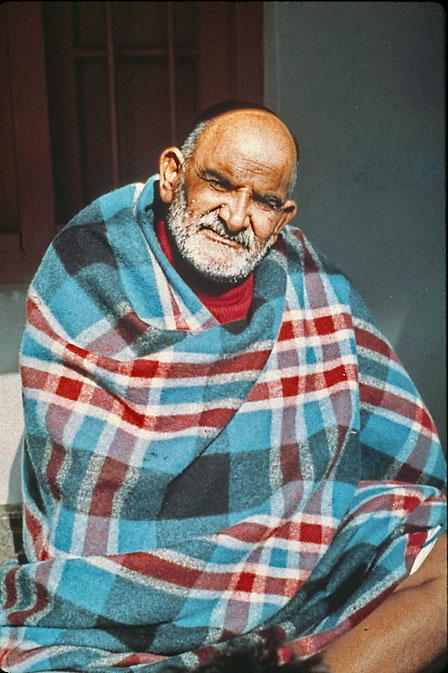
Someone who has only encountered Neem Karoli Baba through a passing reference to Steve Jobs, Virat Kohli or social media can begin to enter the devotional world surrounding Maharaj-ji.
That possibility is larger than the market for spiritual cinema.
Cinema can become a bridge between Bharat and Bharat itself.
India contains countless traditions that remain almost invisible beyond the regions and communities that keep them alive—saints, sacred landscapes, folk deities, local histories, pilgrimage traditions, oral memories, philosophical lineages.
A Maharashtrian may know almost nothing of a ritual tradition in coastal Karnataka. Someone in Bengaluru may have never entered the devotional world surrounding Khatu Shyam. A young Indian growing up abroad may inherit the name of a deity or saint without understanding the cultural world behind that name.
Cinema cannot reproduce the lived tradition.
But it can open a door.
And when it does so without flattening everything into generic “Indian mythology”, the screen becomes a medium of cultural transmission.
That may be one of the most important possibilities opened by Hanuman Ansh—and one of the least discussed.
Perhaps the Audience Never Lost Its Cultural Instinct
For a long time, mainstream Hindi cinema developed a fairly predictable shorthand for aspiration.
The foreign city. The luxury car. The nightclub. The hero who proves himself through swagger, conquest or intoxication. The idea that inherited faith belongs either to the elderly or to a world the modern protagonist must eventually leave behind.
There is nothing wrong with stories set in those worlds.
The problem begins when one aesthetic becomes the default definition of sophistication.
Perhaps audiences are not suddenly “becoming rooted”.
Perhaps they are becoming less embarrassed about what already moves them.
A young Indian does not have to choose between artificial intelligence and Hanuman, Spotify and bhajans, Bengaluru and Kainchi Dham.
Modernity does not require cultural amnesia.
The same confidence may also free our heroes from familiar shortcuts. A man need not constantly prove himself through excess, conquest or swagger; restraint, duty and protection can carry their own strength.
If there is a decolonisation of taste taking place here, perhaps it is this simple:
we no longer need someone outside our culture to tell us which parts of it are sophisticated enough to value.
Anupriya Nagar’s own journey carries something of this symbolism.
At 21, after studying economics at the University of Bath and preparing for a professional life abroad, she became drawn towards Neem Karoli Baba partly through the international fascination around figures who had encountered him. She has spoken about the strangeness of being a young Indian discovering an Indian saint through Western admirers.
Eventually, she put her own savings behind the film.
An Indian looks outward, discovers that the world is looking toward India, and then turns homeward with new curiosity.
There is no rejection of the world in that journey.
Only a recovery of the right to value one’s own inheritance without waiting for permission.
This is also why Bhārata should not be confused with rural India.
Bhārata can live inside a Mumbai studio, a Bengaluru start-up, a university dormitory in London or a diaspora home in California.
Perhaps what has sometimes been excessively metropolitan is not the audience.
It is the industry’s imagination of the audience.
Bollywood Has Noticed. Now Comes the Hard Part.
A few weeks ago, one could still ask whether the industry would notice Hanuman Ansh.
That question has now been answered.
It has.
Ayushmann Khurrana has publicly pointed to the film while speaking about the need for budget-conscious cinema that genuinely connects with people.
A wider faith-centred slate is also beginning to emerge. Haare Ka Sahara, Baba Khatu Shyam Hamara has been announced. Vishal Chaturvedi is developing Rambola, drawing on the legacy of Goswami Tulsidas. Other projects around saints and spiritual personalities are entering discussion.
So capital has noticed.
The danger is that it notices only what is easiest to copy.
A saint.
A temple.
A bhajan.
A few Sanskrit lines.
Some VFX.
A festival release.
That would be to learn the genre and miss the reason.
What made Hanuman Ansh interesting was not simply that it dealt with a spiritual figure. It was the relationship between the subject, the people making it and the audience receiving it.
The shraddhā was not only in the dialogue.
The rasa did not come merely from production design.
And the darśana-like response could not have been manufactured by inserting more religious imagery.
If the next wave of films copies only the visible symbols, audiences will notice that too.
The lesson of Hanuman Ansh is therefore not “make more devotional films”.
It is harder than that.
Trust sincerity.
Allow simplicity to remain simple.
Let faith exist without either mocking it or turning it into compulsory spectacle.
Let the character become larger than the celebrity playing it.
Enter a living tradition with enough humility to recognise that the people watching may know it more deeply than the filmmaker does.
And stop assuming that Indian audiences need their own cultural worlds translated into a borrowed language of sophistication before they will value them.
Vishal Chaturvedi, Shobhinaw Satyaa, Anupriya Nagar and the team behind Hanuman Ansh began with very little of the machinery normally associated with a national theatrical phenomenon.
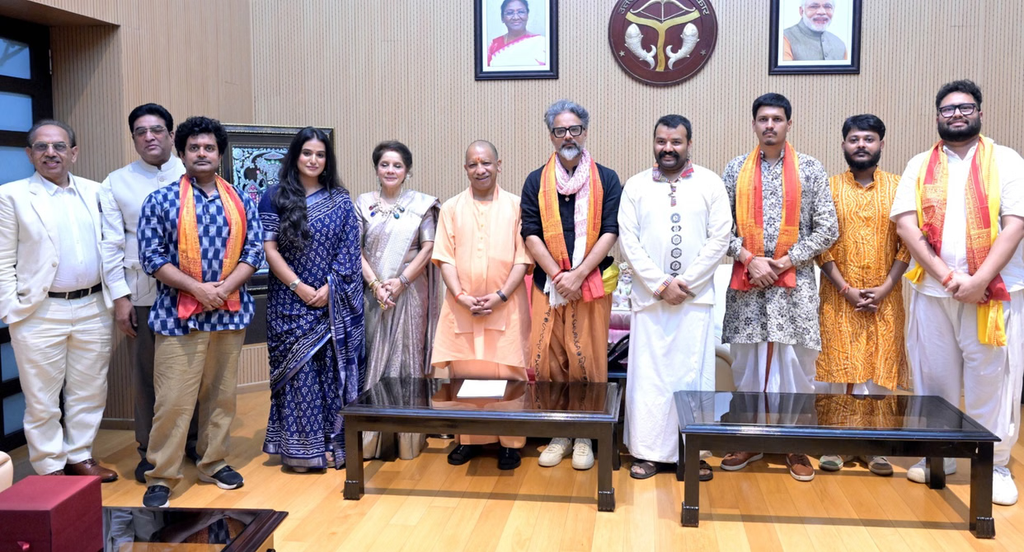
The audience supplied much of that machinery later.
And somewhere between the shrinking screens, returning families, travelling bhajans, conversations around Maharaj-ji and an eighth week that looked nothing like the first, the film became difficult to describe only as a box-office success.
It had begun to move through people.
That is the part Bollywood will find hardest to reproduce.
A studio can commission another saint’s biopic. It can buy larger sets, better VFX and wider distribution. It can study the numbers and identify a new “faith-based” category.
But a movement cannot be commissioned.
It begins when a story touches something that already lives inside its audience.
Perhaps Hanuman Ansh did not create that cultural instinct. It simply gave it a screen.
Bollywood has now seen the result.
The real question is whether it will understand what moved. Maybw the ₹400 crore+ will make the industry notice.

